
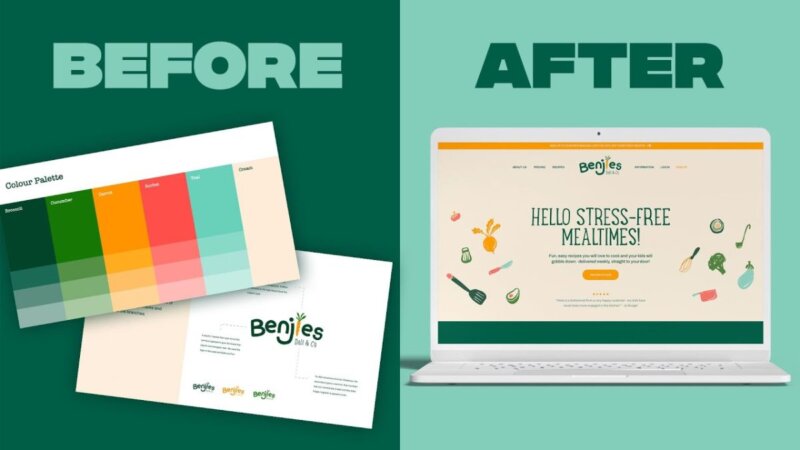
Translating a brand identity into a website is a critical step in the success of any business. The website is often the first point of contact for potential customers and should accurately reflect the brand and its values. In this article, we will walk through the process of converting an existing brand identity into a website, using the example of Benji’s Deli and Co, a subscription food brand focused on family-friendly meals.
First and foremost, the audience should be top of mind when translating a brand identity into a website. Understanding the target demographic and their preferences is crucial. The language, visuals, and content should all resonate with the audience, making the website more appealing and user-friendly.
The next step is to ensure that the brand identity is reflected throughout the website. This includes using the same font systems, color palettes, and imagery to maintain consistency with the existing brand. If the client has limited assets, it’s essential to create a defined color palette, select primary fonts, and use on-brand imagery or graphic assets such as illustrations and iconography.
Equally important for a successful website is the content. Content plays a crucial role in engaging the audience and conveying the brand’s message. While not all designers are writers, it is important to either outsource content creation to a professional writer or learn how to produce content that aligns with the brand’s voice and values.
The design process usually begins with wireframing, which involves planning out the layout and structure of the website. This phase focuses on the placement of various sections and elements without delving into the content itself. Using a grid system, the wireframes serve as a blueprint for the website’s overall design.
Once the wireframes are in place, the high-fidelity wireframes are created, adding in textual content and basic fonts to visualize the final layout. Placeholder text and Adobe XD’s Laura Ipsum plugin can be used to fill in the sections, providing a preview of how the website will look and feel.
The wireframing process is an important stage in the website design as it allows for flexibility and experimentation before committing to a final design. The use of grid systems and icons can aid in maintaining consistency and structure throughout the design process.
In conclusion, translating a brand identity into a website involves a deep understanding of the brand’s audience, maintaining consistency with the brand’s visual elements, and creating engaging content. The wireframing process plays a crucial role in shaping the layout and structure of the website, establishing a solid foundation for the design. By following these key steps, designers can effectively translate a brand’s identity into a compelling and user-friendly website.
Disclaimer:
The information contained in the video or post represents the views and opinions of the original creators, and does not necessarily represent the views or opinions of YeniExpo. The Video Content or Post has been made available for informational and educational purposes only.
YeniExpo does not make any representation or warranties with respect to the accuracy, applicability, fitness, or completeness of the Video or Post Content. If you find any of your copyrighted material in this post or video, please contact us, so we can resolve the issue.
© All rights reserved by respective owners.
Please Share Article Above🔝
Turkish Manufacturers: 5 Proven Ways to Slash Your B2B Logistics Costs
Turkish Furniture Manufacturers: Superior Wholesale Designs for Global Buyers
YeniExpo VIP Services: How We Digitize Complex Industrial Catalogs with Surgical Precision
The 48-Hour Digital Catalog: Why YeniExpo’s VIP Data Entry is the New Standard for Turkish Exporters
How to increase your exports to the Middle East and Europe using YeniExpo
Five Key Advantages for Chinese Exporters Joining YeniExpo.com
Featured Products
Alexandra Wedding Crowns Crystal Stones NEW Awesome Models
RevivaClean Automatic Carpet Washing, Rug Cleaning Machines NEW King Model 270-420cm
Victoria Hall 5 Pieces Embroidery Table Set
KJ Power 7 to 2500 KVA Standard Electric Synchronization System Diesel Power Generators
Anti Aging Cream NEW Doragold Restorative 45ml Night Cream with Vitamin C
Yumatu 7W E27 White Yellow Led Light Bulb 710 Lumens
Teknofalt Complete Stationary Concrete Plants Best-Performing TKN SB 60 M3
RevivaClean Carpet Rug Spinning Machine from 120-520 cm Rug With
Woman Wholesale Glamour Dress Long Sleeve Baby Blue Color 100
[the_ad_group id="19807"]