
Understanding Mortgages: A Beginner’s Guide
When it comes to purchasing a home, most of us will need to take out a mortgage in order to finance the purchase. It’s important to have a clear understanding of what a mortgage is and how it works before getting into the numbers. In this article, we will break down the concept of a mortgage and explore the key components involved in paying off a home loan.
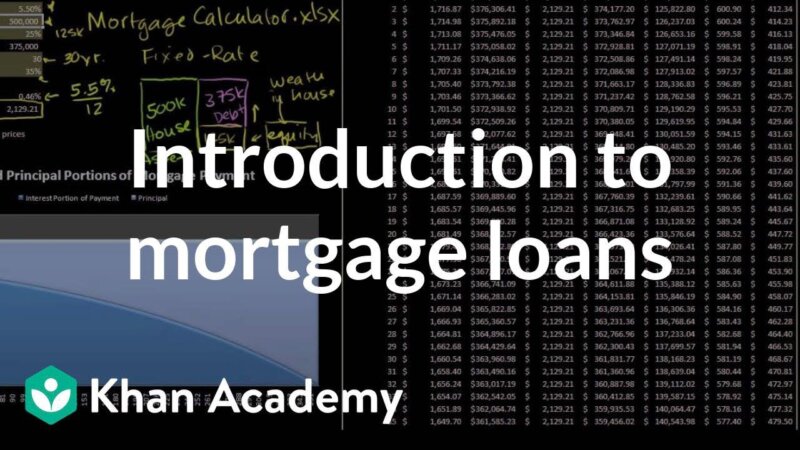
To begin with, let’s take a hypothetical example. Let’s say there’s a house that you want to purchase, and the price tag is $500,000. You’ve managed to save up $125,000, which accounts for 25% of the total purchase price. Now, in order to cover the remaining balance of $375,000, you’ll need to apply for a mortgage from a bank.
When you take out a mortgage, the bank becomes the lender and you, as the borrower, are required to pledge the title of the house as security for the loan. Essentially, the bank holds the title of the house until the mortgage is fully paid off. This process of securing a loan using the title of the house is what defines a mortgage. The term ‘mortgage’ originates from the old French words ‘mort’ meaning dead, and ‘gage’ meaning pledge, signifying that the pledge will be released once the loan is repaid.
Now, let’s delve into the numbers. Using a spreadsheet, we can calculate the monthly mortgage payment based on the loan amount, interest rate, and term of the loan. For instance, with a 5.5% interest rate, a 30-year fixed-rate mortgage, and a $375,000 loan for a $500,000 house, your estimated monthly mortgage payment would be around $2,100.
In terms of financial terminology, the house represents an asset with a value of $500,000, while the mortgage loan is a liability of $375,000. Your equity in the house, which is the difference between the value of the house and the remaining mortgage debt, would be $125,000, reflecting your initial down payment.
It’s important to note that the value of the house can fluctuate over time, which could impact your equity. By understanding these financial concepts, you can gain a clearer perspective on the dynamics of a mortgage and make informed decisions about homeownership.
In conclusion, a mortgage is a financial tool that enables individuals to purchase a home by obtaining a loan from a lender. It involves the transfer of the title of the house to the lender as security for the loan, with the pledge being released once the loan is fully repaid. By understanding the calculations and financial implications of a mortgage, you can make well-informed decisions when navigating the housing market.
Disclaimer:
The information contained in the video or post represents the views and opinions of the original creators, and does not necessarily represent the views or opinions of YeniExpo. The Video Content or Post has been made available for informational and educational purposes only.
YeniExpo does not make any representation or warranties with respect to the accuracy, applicability, fitness, or completeness of the Video or Post Content. If you find any of your copyrighted material in this post or video, please contact us, so we can resolve the issue.
© All rights reserved by respective owners.
Please Share Article Above🔝
Turkish Manufacturers: 5 Proven Ways to Slash Your B2B Logistics Costs
Turkish Furniture Manufacturers: Superior Wholesale Designs for Global Buyers
YeniExpo VIP Services: How We Digitize Complex Industrial Catalogs with Surgical Precision
The 48-Hour Digital Catalog: Why YeniExpo’s VIP Data Entry is the New Standard for Turkish Exporters
How to increase your exports to the Middle East and Europe using YeniExpo
Five Key Advantages for Chinese Exporters Joining YeniExpo.com
Featured Products
Aksan Savon De Royal Luxury Hand Wash Soap White Eden Black SR101
Amazon Black Abaya with Ruffle Details A237224BK
Argentina Grills BBQ Outdoor/Indoor Turkish Made NEW 2021
Pasteurizer
Tek-El Makina Vertical shaft impact crushers 60 – 450 Metric Tons per hour capacity
Smoker Ovens Indoor BBQ Style Perfect Turkish Made NEW 2021
Exquisite GOBİ Black Abaya A237217BL Turkish Djellaba Hijab Women Caftan
Berberler Rebeka Men Women Family 100% Turkish Cotton Bath Robe Bathrobe Brown White
Women Shirts Long Tunic AMAZİNG Marie Mcgrath 3011
[the_ad_group id="19807"]